
Common Property Line Issues in Alexandria’s Historic Neighborhoods
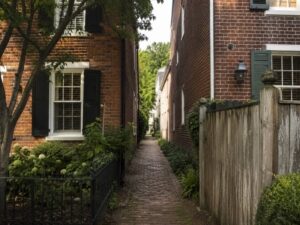
Property line issues turn up often in old historic neighborhoods, where the parcels were laid out long before modern tools existed. A line drawn with a chain and a compass two centuries ago rarely matches a survey done today without some work. Walls, fences and narrow passages add their own puzzles. Understanding these common issues helps an owner know what a survey may uncover.
Modern Measurements Applied to Parcels Created Under Older Standards
Old parcels were measured with tools and units that feel foreign today. Surveyors used chains and poles for distance and read directions with a magnetic compass. A deed might describe a line in poles rather than feet, with a bearing tied to magnetic north.
Converting these old measurements takes care. A pole equals a set number of feet, and a magnetic bearing has to be adjusted for how the compass reading has drifted over centuries. A surveyor works through these conversions to compare the old deed with a modern survey.
Small differences add up on an old parcel. Approximate original measurements, rounded in the deed, can leave a modern survey slightly off from the written numbers. The surveyor weighs the historic description against what the ground shows.
Walls and Fences That Predate Current Ownership Records
In a historic neighborhood, a wall or fence may be older than any current record. These structures have often stood for generations, marking a line people have long accepted. Their age gives them weight, though it doesn’t automatically make them the boundary.
A rebuilt wall complicates the story. A fence replaced over the years may sit slightly off from the original, and different wall faces can suggest different lines. The surveyor studies how the structure relates to the deed and the corners.
Long use still matters in the analysis. A wall that has marked a line for a century carries real evidentiary value. The surveyor weighs that history alongside the written record rather than dismissing either one.
Narrow Passages and Shared Access Between Historic Properties
Old neighborhoods are laced with narrow passages between buildings. Alleys, paths and service corridors often run along or between lots, and their ownership isn’t always obvious. Some belong to one owner, while others are shared.
Access rights can exist apart from ownership. A recorded right may let one owner use a passage that another holds. These rights can be documented separately from the land itself, which surprises owners who assumed the passage was theirs alone.
A survey and a records check clarify the situation. Together they show who owns each passage and who may use it. That answer matters before an owner blocks, gates or builds near a shared way.
Additions and Projections Built Close to the Parcel Edge
Historic homes often sit close to their lines, with features that push right up to the edge. Steps, bay windows, porches and roof overhangs can all reach toward or across a boundary. On a small historic lot, these projections need precise location.
Foundations and drains add hidden complications. A footing or a downspout that crosses a line can create an encroachment an owner never noticed. The survey measures these features exactly so their position is clear.
Knowing where projections sit prevents conflict. A planned addition has to account for what already crowds the line. Accurate measurement keeps a new project from worsening an existing overlap.
Combining Historic Research with Current Field Evidence
Settling a historic boundary takes both old paper and new fieldwork. The surveyor gathers deeds, plats and historic maps, then compares them against monuments and adjoining records found on the ground. Neither source answers the question alone.
Physical occupation joins the analysis. Long-standing walls, fences and use patterns all serve as evidence alongside the written record. The surveyor weighs these together, guided by the rules that govern how boundary evidence ranks.
This blend produces a defensible line. A conclusion built on both history and current evidence stands up better than one leaning on either alone. In a historic neighborhood, that combined approach is what a careful survey delivers.
Frequently Asked Questions
Can a historic fence establish the legal property line?
Sometimes, but not automatically. A long-standing fence can serve as evidence of a boundary, especially when it matches the deed and the corners. On its own, though, age doesn’t make a fence the legal line. A surveyor weighs it against the written record and other evidence.
How are old measurements converted for a modern boundary survey?
A surveyor translates old units like poles and chains into feet, then adjusts historic magnetic bearings to modern references. These conversions let the old deed be compared with current measurements. The work takes care, since small errors in the original can carry through.
Can a shared passage exist even when it is not separately owned?
Yes. A passage can be owned by one party while others hold a recorded right to use it. Ownership and the right of access are separate matters. A survey and a records search reveal both, so an owner knows who controls a shared way.
For a free land surveying quote, call us at (571) 200-5708 or send us a message by going here.
Posted in land surveying, land surveyor
