
How Boundary Surveys Help Preserve Property Rights During Historic Neighborhood Renovations
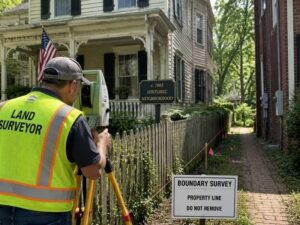
A boundary survey protects your property rights when you renovate a home in a historic neighborhood, where the old records rarely tell the full story. Deeds and plats in these areas can date back generations, and the markers that once defined each corner may be long gone. Renovating near an unclear line risks a dispute with a neighbor or a costly redo. So a survey clears up the boundaries before the work begins, which keeps your rights intact.
Historic blocks carry layers of change from owners who came before you. Fences shifted, additions crept outward and shared walls blurred where one lot ends and the next begins. A survey cuts through that history to show what you actually control today, and that clear answer is worth having before a single board comes off.
Historic Neighborhoods Often Have Older Boundary Records
The paperwork behind a historic lot can be old, hand-drawn and hard to match to the ground. A plat from decades ago may reference landmarks that no longer exist. Corner markers set long ago might be buried under a garden or a driveway, which leaves the true line open to argument.
All of that uncertainty makes the boundary a fair question rather than a settled fact. A surveyor compares the old records with careful field measurements to settle it. The result is a clear line where there used to be only guesswork, and that line gives your whole project a firm footing.
The age of a neighborhood can also mean the surrounding lots were split and resold many times. Each split added a fresh description to the record, and those descriptions don’t always agree with one another. A surveyor works through that pile of documents to find the version that holds up, which settles arguments the paperwork alone could never resolve.
Renovations Can Raise New Property Line Questions
A renovation often touches the edges of a lot, which is exactly where boundary questions surface. Adding a porch, extending a garage or replacing a fence forces the question of where your land really ends. In older neighborhoods, that answer isn’t always obvious, and a wrong guess can spark a quarrel next door.
Renovation work that can raise boundary questions includes:
- Building a new fence along a long-assumed line
- Adding a porch or deck near a side yard
- Extending a garage toward a neighbor’s lot
- Replacing walls that sit close to a shared edge
Boundary Surveys Help Owners Understand What They Actually Control
Owners sometimes assume the fence or hedge marks their line, only to find the real boundary sits elsewhere. That gap between assumption and fact can derail a renovation partway through. A survey replaces the assumption with a measured, reliable line before any of that happens.
Knowing what you truly own lets you plan the work with confidence. You can position an addition or a fence where it belongs, not where a guess puts it. That certainty keeps the renovation firmly on your side of the line, and it gives you solid ground to stand on if a question ever comes up.
Property Rights Matter Before Work Near Shared Edges
Historic homes often sit close together, with party walls, narrow side yards and shared alleys between them. Work near those shared edges calls for extra care, since the line may run through space both owners use. A survey shows exactly where your rights stop and your neighbors begin, which takes the guesswork out of a delicate spot.
That clarity protects you when a project brushes up against a shared feature. You can build right up to your limit without crossing it. Respecting the true edge keeps both owners on good terms, and good terms make the whole renovation easier.
Shared edges also carry a higher chance of an honest overlap, since two old structures may lean toward the same strip of ground. A survey shows whether a porch step or a wall footing crosses the line before the work makes that overlap permanent. Catching it early keeps a friendly fix from turning into a legal one.
Why Boundary Clarity Helps Avoid Neighbor Disputes
Many boundary fights start from an honest mistake about where a line falls. When both owners can see a measured survey, the guessing stops and the tension eases. Clear lines give everyone a shared fact to work from instead of two competing hunches.
A survey done before construction heads off conflict before it starts. Neighbors know what to expect, and the work stays within its bounds. That openness keeps a renovation from souring a relationship next door, which is worth far more than the cost of the survey.
Frequently Asked Questions
Why are historic neighborhood boundaries harder to confirm?
Older records, missing markers and decades of small changes can blur where a line truly falls. A surveyor pairs the old documents with field measurements to pin the boundary down again.
Can a boundary survey help before renovation?
Yes. It shows where your property lines sit before you build, so a new fence, porch or addition lands in the right place. That clarity keeps the project from crossing onto a neighbor’s land.
Should owners survey before building near a shared edge?
Confirming the line first is the wise move whenever work sits close to a party wall, alley or side yard. Knowing exactly where your rights end lets you build up to the limit without overstepping it.
For a free land surveying quote, call us at (571) 200-5708 or send us a message by going here.
Posted in Boundary Surveys